On several days during Muharram Islamic Month, the
fishermen of southern Ciamis, West Java, do not go to their work. Instead, they
take part in preparing many traditional art exhibitions and work together in
preparing a big party. Those fishermen worked up on this not because they
cannot go to sea due to lack of fuel or high tides : they did this to follow
the old ritual of hajat laut.

picture : harapan rakyat
Ritual of Hajat Laut (Hajat = party. Laut = sea). That
was the name of the big party mentioned before. It is a ritual held by the fishermen
of Southern Ciamis, West Java, that was done for many years. Even so, the
ritual also takes place in many neighboring places, such as Sukabumi and even
Cilacap, in the neighboring province.
Hajat itself means pesta, which is party in
Bahasa. Referring to that phrase, hajat laut can be interpreted into a party of
people who lives in the seaside. The party in Hajat Laut itself is held as a
means to celebrate and to thank God for the fish caught by the fishermen, and for
the divine protection that the fishermen received during their voyage.
Prior into the present time, the ritual was held by
drowning a water buffalo’s decapitated head into the open sea, along with so
many side dishes which the people called sesaji. People of the southern seas of
Java Island believed - and some still believes - that the southern coasts of
Java Island was protected by a divine and invisible soul called Nyi Roro Kidul.
Later, Islam took hegemony on the people of Java, which forbids any kind of
believe in Gods but one God. Since that time, The Hajat Laut became interpreted
into an expression of thanking God for whatever bless that those fishermen
received. Some elements of the ritual, like the drowning of a decapitated water
buffalo’s head, therefore become non-exist, and the drowning of side dishes is
now only part of symbolic meaning. Islamic prayers and preaches were now added into
the ritual.
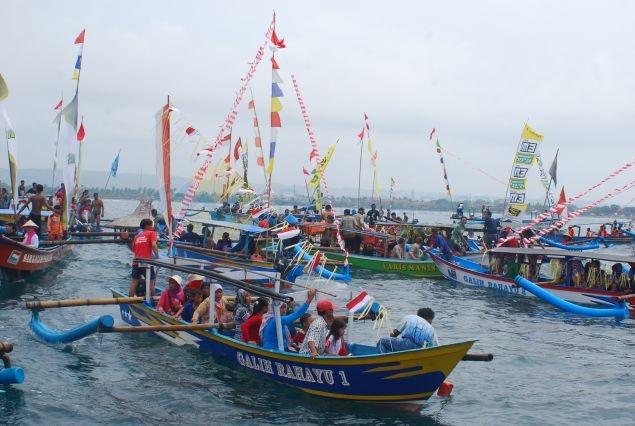
Generally, The Hajat Laut will start with a
mass preach by a Moslem preacher, right on the night before the ritual. At noon
on the day after, the ritual starts. People will start to recite the Holy Quran
before bringing the sesaji into a boat. Many people following thereafter, and some
people will take the lead and take off into the boat, bringing with them the
sesaji. After reciting the Holy Qoran once again, they release the sesaji that
they brought, vanishing into the open sea.
The ritual of hajat laut has happened since
many generation before the current generation. It has therefore become a
symbolic trait for people living in the southern coast of West Java. And of
course, it also becomes a magnet for tourist who are curious to see the culture
people of West Java, Indonesia.


